



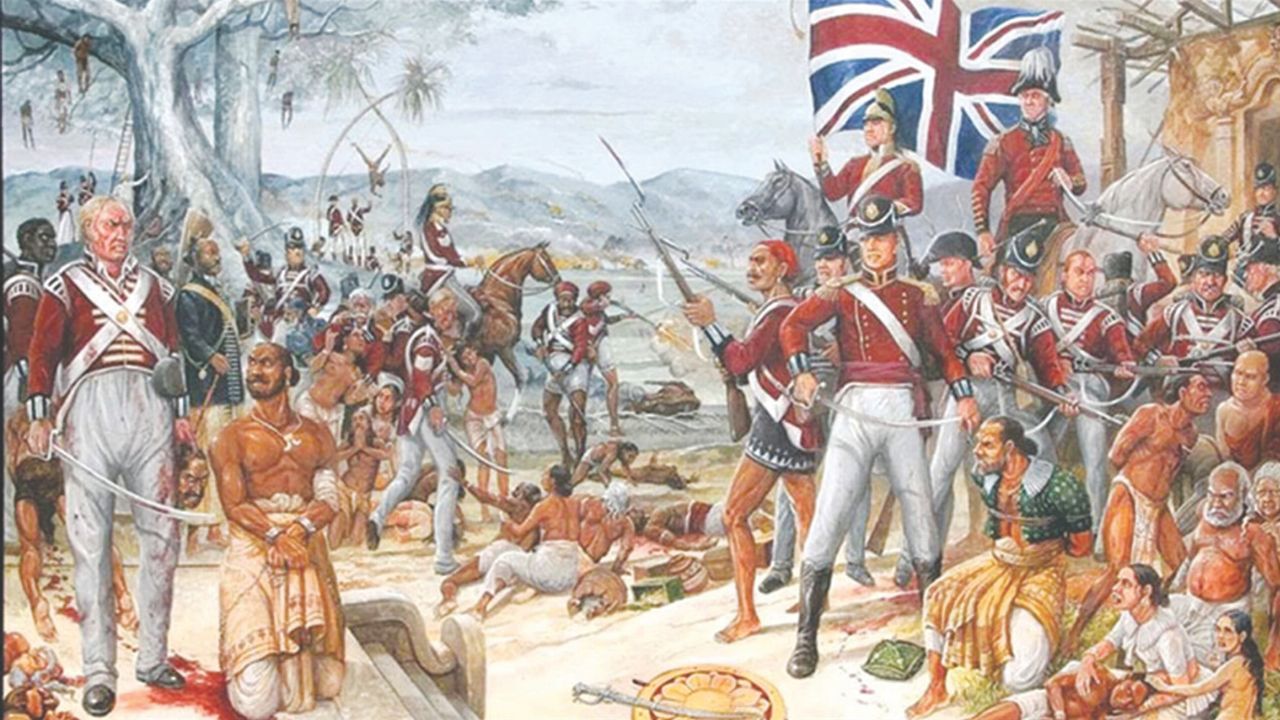
As children, we felt a chill of excitement when we heard how Ali Baba, a poor wood-cutter from the forest, found a treasure in a cave full of gold. It gave us goosebumps. Similarly, many other stories had such enticing thrill when the character of the novel or the movie suddenly finds abundant wealth. The story of the Sub-Continent is much similar and gives sequential resemblance. A colonizer, in long search of raw-material and wealth, suddenly finds a goose that lays golden eggs. It, with political and colonial acumen, colonizes the region.
Sub-Continent was the goose that laid the golden eggs for Britain. So, how Britain was successful to kill the goose and takeaway all its laid golds. At the moment when Britain left, the goose had already succumbed to death. During the seventeenth century, Britain shared about 1.8% of World’s GDP; however, Sub-Continent shared 23%. By the end of 1940, Britain accounted about 10% of the world GDP, meanwhile Sub-Continent stood as a poor and third-world country. The literacy rate was at 16%, life expectancy about 27 and about 90% people living below the poverty line. These statistics lead to a jarring split-screen of the image of the difference between Britain and the sub-continent after and before the partition.
Similarly, in an article in Al-Jazeera titled, “How Britain stole $45 trillion from India” by Jason Hickel, explains that how Britain was successful to drain out the sum during the time period of 1765-1938.
How Britain executed the greatest economic robbery of the world?
How a large chunk of money was stolen? Jacson answers that with the help of trade system. He says that before 1765 Britain bought goods from the Indian producers and paid them mostly in silver. But, the story changed after 1765 when Britain successfully established its monopoly over trade.
The East India Company (EIC) started to collect taxes and paid for the purchased goods from the revenues collected; for instance, the peasants of Sub-continent were paying for their goods. Instead of paying for the purchased goods, the Britons got them for free. Some of the goods ended up in European markets as British manufactured goods while others i.e. iron and timber where used for Britain’s industrialization. Same is true when Tharoor makes the point that, “Britain’s industrialization was India’s deindustrialization.”
When the monopoly of EIC was over and the British Raj took the reins of power in Sub-Continent, the exploitation didn’t end but was fueled via different forms. At the end of EIC domination, peasants of sub-continent were able to export their goods to other countries. However, Britain was successful to make sure that the payment came in their hands.
How was this made possible?
Those who wanted to purchase the Indian exported goods or other raw materials had to purchase a ‘special Council Bill’ from London. Britain made it mandatory for the countries who aimed to purchase the exported goods from the Indians. The ‘Council Bill’ was a currency paper issued only by London. And, to get the bill one had to purchase it in only gold and silver. Interestingly, the traders from the world purchased the bill in gold and silver from the Britons and paid the Indians the Council Bill for their goods. The sub-contintenians on the other hand cashed the bill at local level from the treasured money that had been collected from them. All in all, Britain again was getting golds and silvers and paying nothing instead. On the one hand, the people of sub-continent were paying for their own goods from their own money and Britain’s treasure money and gold was increasing.
Many of my readers might disagree with naïve arguments that while colonialism was not great but Britain gave sub-continent trains and education and we should be thankful for that. The construction of railway in sub-continent was not for altruism but for strategic interests. The railway tracks were constructed to export the extracted goods from the sub-continent to the shores of Britain’s ships. Britain was prospering at the altar of the looted ‘maals’ from her colonies and left the goose when it was fragile, succumbing to death and laying no more golden eggs to increase the wealth of Britain’s national exchequer. And, at the end of the story the goose died and the founder of the wealth left unceremoniously to leave the blame on the goose for its fault.
This is the greatest economic robbery in the history of the world. Through this system of Council Bill, Britain was able to extract approximately $45 trillion. Apart from the stolen money, Britain also possess the mega Kohinoor diamond specifically mined from the sub-continent and reaching the British shores. This diamond is now a part of the British Crown Jewel and is set in the Crown of Queen Elizabeth. Making it a proud colonization history, Britain has looted its colonies and its subjects while displaying the diamond in the London Tower for public exhibition and filling its museums from the extracted goods through its colonies.
Like the story of the King Mildas who got powers that whatever he touches would turn to gold. At first he was overjoyed, but soon realized that his food, drink—even his daughter—turned into gold. His blessing turned into a curse only to starve in the midst of riches, Britain’s hunger for wealth from the Sub-Continent consumed the very land that sustained it. For Britain, the Sub-Continent was both King Mildas’s golden touch and the goose that laid the golden eggs—a land of abundance, wealth, and industry. But instead of nurturing it, the colonizer drained it dry, sipping away all its blood and only leaving the goose dead and the land in ruins.
About the author:

Jahanzaib Mengal
Inspector of PoliceJahanzaib has done his graduation in BS Hons in International Relations (IR) from Quaid-i-Azam University, Islamabad. He writes on international politics, Indian Ocean dynamics, and national security issues. Currently serving as an Inspector of Police in Balochistan’s Home & Tribal Affairs Department, he has also published a research article, “String of Pearls and Necklace of Diamonds: Sino-Indian Geo-Strategic Competition in the Indian Ocean”, in the Asia Pacific Journal (open access).