




Not all books are read for examination. Some books are read and written to win hearts, to enter the mind, and to make history. A book can be complete with valuable information, for instance, Why Nations Fail by Daron Acemoglu and James A. Robinson. However, they both argued about the rise and fall of the nation, the origin of power, prosperity, and poverty.
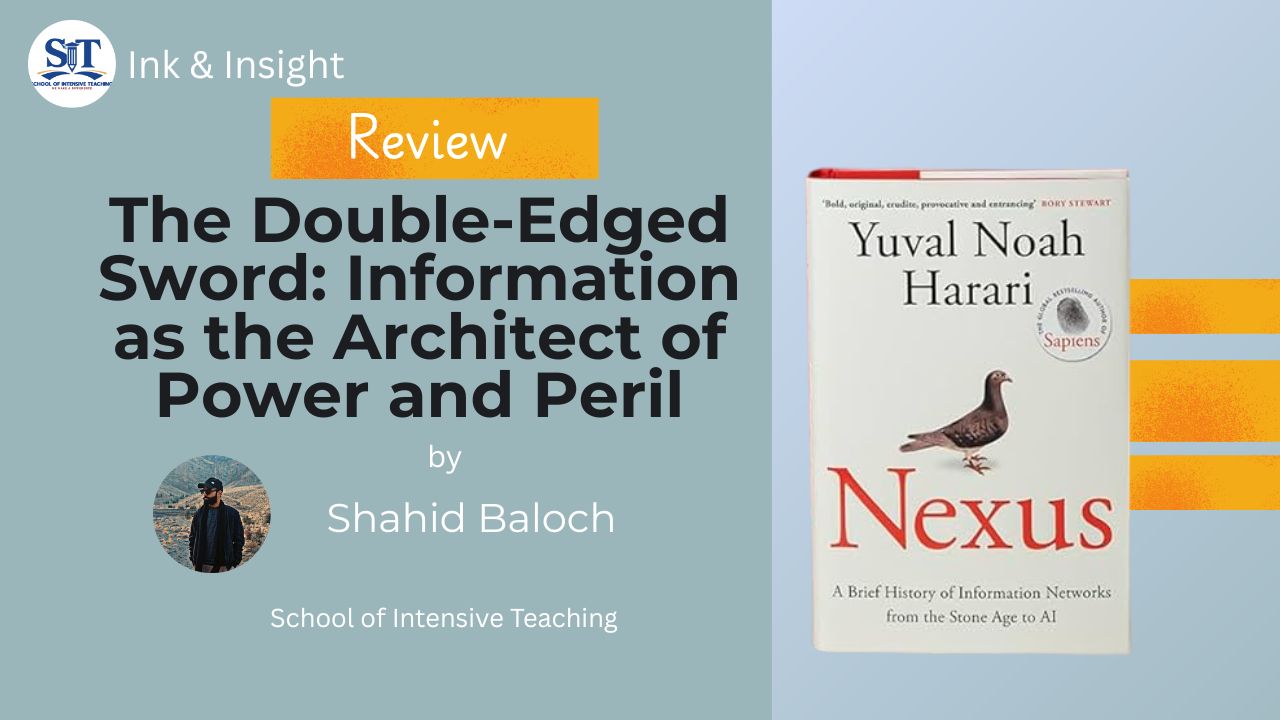
Apart from ‘Why Nations Fail’ by James Robinson and Acemoglu, Yuval Noah Harari, has recently written ‘Nexus’, which has won the hearts of thousands of people. In the article, we will discuss the Nexus. This review is a short and brief introduction of the book: to introduce the readers to the book.
In Nexus, Yuval Noah discusses the information, its role, and the rising threat it poses. Remarkably, it took billions of years to name our species Homo sapiens, meaning ‘wise human’. If one thinks and analyses. It seems like debating how well we have lived up to our name. Despite the passage of thousands of years, one can still identify how information has served as the cornerstone of innovation, discovery, and conquest. Being so wise, we still can’t prevent the existential hazards and ecological collapse caused by the misuse of information and power. Drastically, we (Sapiens) empowered ourselves with information.
However, defining information has remained a controversial topic. Interestingly, philosophers and scientists have long debated what “information” really means. Claude Shannon, the father of information theory, described information as a measurable quantity that could be transmitted through a channel. Similarly, Norbert Wiener tied it to the workings of communication and the control in living system. Many people have in fact associated information with human-made symbols, scripts, spoken words, or written language. Throughout human history, inventions have transformed and changed information and have made it more productive and sophisticated—improving connectivity and cooperation. These invented technologies were developed by humans, stemming from the art of storytelling.
To put it simply, Yuval Noah Harari has argued in his book that one can manipulate the public by using information from democracy to transition to dictatorship, and how a single piece of misinformation can undermine the entire democratic principle. In contrast, we should also be thankful for information technology, which enables large-scale democracy. Clearly, it is evident how the government curtails the gathering of information. It is not only used by politicians but also by giant companies. Given the reality, we are ultimately at risk of losing our future.
Transforming societies from agrarian to agricultural information played a potent role. To say the least, unfortunately, we avoided the futuristic threat that is an alarming stage. Dragging new information, making discoveries, 54 thousand species have vanished since Industrial Revolution.
In the era of the battle of narration, one can see from the recent war between Pakistan and India. It seemed that the weaponization of information had taken place. Claiming that shooting down six aircraft from both sides has dispersed the cloud of terror in both sides’ nations. Calling it the battle of narration would not be wrong.
If one thinks and analyzes, “Harrai, one can agree that power and information are two sides of the same coin .” Definitely, information empowers both powerful and weak politicians. The rise and fall of politicians totally rely on information. Therefore, the desire for change is only possible through monitoring information. Power lies where the network of information emerges. Whoever controls the flow of information will eventually control the state. Let’s take a historical example, Tiberius and Sejanus. Tiberius was the second Roman Emperor after the death of Augustus. Tiberous trusted no one except Sejanus and made him perfect of the Pretorian Guard, expended it into an army of 12 thousand as well as additional role of policing and administrating the city of Rome Finally, Sejanus persuaded Tiberous to move out of the capital to Capri, arguing that it would be much easier to protect the emperor on a small island than a crowded metropolis full of traitors and spices. In truth, Sejanus aimed to control all the information reaching the emperor. This was the symbol that the emperor was in control. However, all information reaching Tiberius and the emperor indicated that the praetorian commander had become the true ruler of the empire. Now, Sejanus purged anyone who might oppose him__ including members of the imperial family. Since nobody contacted without Sejanus’ permission, Tiberius seemed to be a puppet.
To cap it all, though information has undermined democracy and frayed the ecology, it has also opened the gate for large-scale democracy.
About the author: