



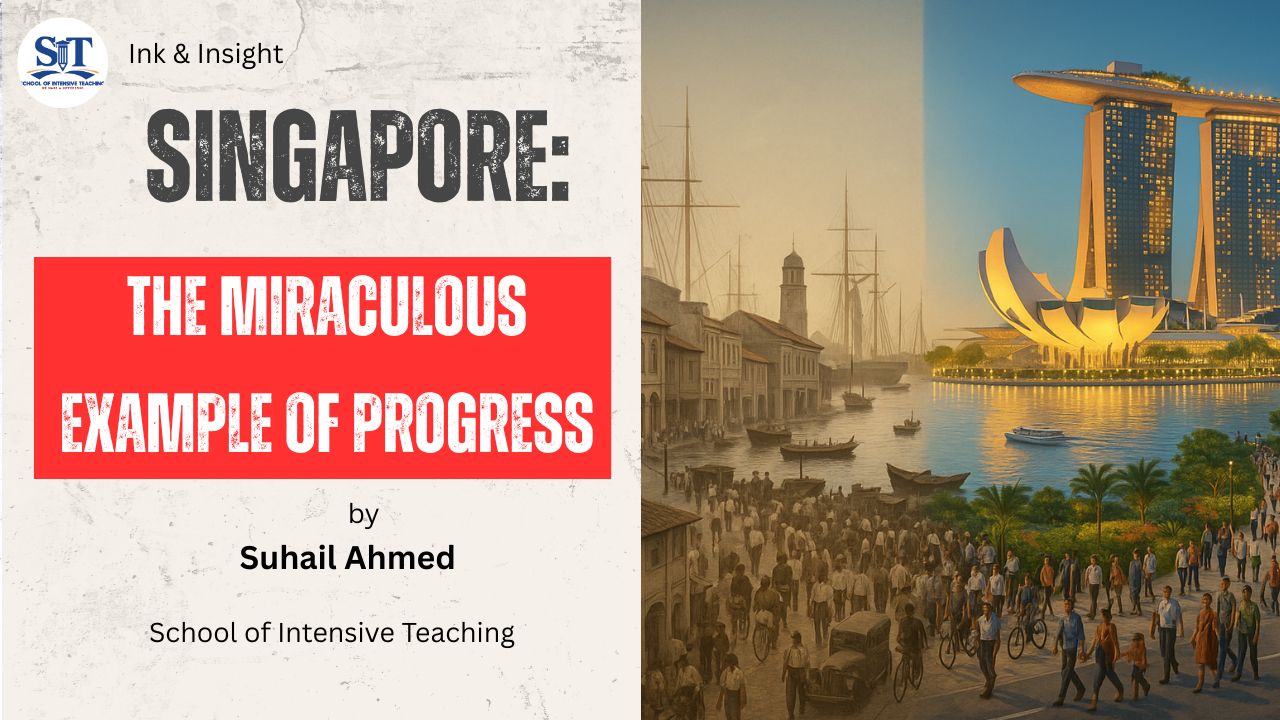
In this contemporary era, Singapore is considered the epitome of progress. It ranks among the top four Asian tigers —South Korea, China, Taiwan, and Singapore —that have achieved miracles in every development field. Similarly, it is among the top four least corrupt countries in the world and the top in Asia for the past decade. Presently, Singapore stands as a society without religious intolerance, ethnic, and linguistic bias. Unfortunately, the scenario of Singapore was not so in the past; behind the glittering curtains of Singapore’s current development was another tarnishing side – a country full of crimes, drug addicts, unemployment, and food scarcity. It was even colonized by the giants of World War II, such as Japan and Britain, turning Singapore into a colonial slum. After going through such harsh conditions, the recent progress of Singapore compels a rational mind to wonder: How did such a densely populated country, devoid of natural resources and minerals, rise to such remarkable heights of progress? What policies were adopted, and how were they implemented? Without material wealth, what forces enabled this Asian Tiger to be the pinnacle of success? And who was the visionary leader behind this transformation?
Background: The Story of Singapore’s Hardship and Underdeveloped Era
During the Indonesian rulers’ regime, the island served as a trading hub for Chinese, Indian, and Arab traders. Later in 1819, British East India Company officer Thomas Raffles bought Singapore and turned it into a free trade zone. After the Suez Canal construction in 1869, it became a major hub for the trade route. From here, the unfortunate and tarnished phase of Singapore’s decline begins. Many traders from Bengal and the neighborhood grew opium. They processed it in Singapore, increasing drug addiction and the crime rate. As it is said, when it rains, it pours; to worsen the condition already induced by drug addicts and criminals, Japan invaded Singapore on 12 February 1942. For the next three and a half years, Singapore suffered immensely- its people starved to death, its buildings turned into ruins, and poverty and unemployment suppressed its economy. Citizens of Singapore exhaled a sigh of relief when Britain defeated Japan in World War II.
Elections of 1959: The Start of the Miracle
After WW II, the British took control of Singapore; the citizens favoured Britain, as it had defeated Japan, and the Labour Party was in rule, which was against imperialism. Finally, in 1959, proper elections were held; a young visionary leader, LEE KUAN YEW, became Singapore’s first Prime Minister. From here, the island’s transitional period began. Initially, the P.M. wanted to merge Singapore with Malaysia, providing Malaysia with 40 percent of its revenue, but this could not happen. Finally, in 1971, Britain left Singapore; now it was up to Prime Minister Lee to survive by doing miracles or suffering like before. Mr. Lee was aware of limited material wealth and the danger of being diversely so rich. To address issues such as crime, corruption, defense, economy, and diversity, Lee Kuan Yew took the following pragmatic measures.
Pragmatic Measures that made what Singapore is today:
Formation of Amicable Relations with Neighbors:
Being fully aware that prosperity and security can not be pursued in isolation, the Prime Minister emphasized on building friendly relations with Singapore’s neighbours.
Building the foundations of the ASEAN group:
ASEAN (Association of Southeast Asian Nations) was founded in 1967. Singapore, however, was among the major founding members of ASEAN. The rudimentary purpose of this bloc was to maintain peace and cordial relations in economic, social, cultural, technical, education, and other fields. Thus, this alliance helped Singapore in its progress.
Introduction of National Service:
After collaboration with neighbors, defense is the key to securing the nation’s sovereignty from other invading powers. Therefore, the head of the government made it mandatory for every Citizen to register for national service at the age of 16. Later, at the age of 18, it became compulsory for citizens to join either the Army, the defense forces, or the national services. This step enhanced the country’s security against nearby invading powers.
Pragmatic Measures by the Prime Minister to Ensure Integration:
Formation of a Secular State:
The head of the Government, Mr. Lee, was fully aware of the potential for religious, ethnic, and linguistic diversity to cause intolerance among citizens. Lee laid the foundation of secularism by ensuring that all citizens are equal and no language is superior to others.
Introduction of Ethnic Integration Policy (EIP):
Under this policy, it became compulsory for the different ethnic groups of the country to live near each other in a single building or in the neighbourhood with a fixed ratio. At the same time, the percentage of ethnic groups in the building was maintained in accordance with the country’s ethnic group ratio. This remarkable policy was introduced to prevent division, promote integration, and foster strong social bonds among diverse ethnic groups.
Maintenance of Religious Harmony Act 1990:
This act ensured that citizens from different religion can live peacefully. It bridged the gap between various religious groups. Under this act different religious scholars were chosen to represent their religion. The role of these representatives was to facilitate interaction among people from other faiths while highlighting religious views that foster unity.
Racial Harmony Day:
From the beginning of a child’s life, principles of secularism, diversity, and unity are instilled. Every year on 21 July, Singapore celebrates Racial Harmony Day. The celebration of this day begins at school. The school children dress up in the costumes of other religions—a Hindu will dress in Muslim attire and vice versa.
Reforms in Education and Health:
Education is the foundation upon which nations are built. A similar striking example is of Singapore; how through education real development was introduced. Singapore implemented the Triple Helix policy, which combines education, academia, and skills. The island has built excellent infrastructure and implemented free, quality education for its citizens. In the same way, it was made compulsory for every citizen to acquire education from primary to college level. Regarding skills, a law was passed that made it mandatory for companies and academies to develop the skills of citizens. For this, the government paid a skill development levy to companies and academies.
Parallel to the development of education and skills, the health sector was also equipped with sophisticated technology at a low cost.
Reforms to Avoid Corruption:
There is no denying the fact that Singapore’s success is linked to the uncompromising stance against corruption. This single stance transformed it from a struggling port to an emerging harbour. Investors were attracted not only by its location but also by the credibility of a corruption-free system. The nation’s progress proves that when corruption is eradicated, meritocracy and efficiency naturally pave the way for prosperity. The anti-corruption policies by Lee Kuan Yew became the engine for economic growth.
Measures undertaken by the Prime Minister to Reduce Corruption:
Applying the Theory of Reward and Punishment:
The head of the government increased the salaries of the employees and politicians. The employees of Singapore are among the highest paid in the world. Likewise, currently the P.M of Singapore is the highest paid P.M- paid more than Trump and Putin. The employees and politicians who performed efficiently were rewarded with bonuses.
Besides the reward system, punishment was also a key in curtailing corruption. Anyone accused of corruption was put in jail for up to 10 years and fined 1 lakh dollars.
Formation of the Prevention of Corruption Act:
Under this act, a Corruption Bureau was formed, totally independent. Powerful. Though the Burreau was under the Prime Minister office but the PM could not interfere in its process. It has such powers that it can question the accountability of top politicians and even put the accused in jail.
Environmental Reforms:
Lee’s only concern was not only human development and economic stability but also ensuring environmental friendliness. To implement this policy, the P.M. initiated a National. Tree Planting Day in 1972. It was so impactful that within 10 years, the ratio of trees equalled the citizens living on the island. The density of pollution was another concern; issues like traffic and urbanization can throttle daily life activities. The visionary guide of Singapore introduced a high tax system, up to 100%, on personal vehicles, while making public transportation one of the cheapest and most efficient in the world. Similarly, taxation on private property compared to government schemes was significantly higher.
These reforms, spearheaded by the far-sighted leader, are quintessential examples for the rest of the underdeveloped countries, showing how citizens who were once starving to death now live a prosperous life.
Now, questions arise in a rational mind: where did all this money come from? Singapore with limited material and sources, how the beautiful island managed to make its limited material suffice for its development?
Where Did all the Money Come From?
Singapore had no oil, gas, or vast mineral wealth. Still, its wealth was generated from trust, location, human capital, and sound governance. Discipline, credibility, and a corruption-free state were its proper resources, transforming the island into a state of prosperity.
Proper Utilization of its Location:
Geography serves a major role in the progress of any country, if utilized properly. Similarly, Singapore’s location provided as an asset—positioning it as a global trade hub between East and West. Through the proper use of its strategic location, the island attracted shipping investment and banking. The port of Singapore turned to be one of the busiest in the world leading towards steady revenue. Lee Kuan Yew further convinced foreign investors that their money would be safe through his anti-corruption policies. Thus, capital inflow from multinational corporations especially in finance, electronics, and petrochemicals, became the real source of income.
Investment in Human Capital:
Education and skills development were prioritized over luxury projects. People were made so skilful that every citizen became an asset to generate income.
Use of Diplomacy and Soft Power:
Strategic Alliances and cordial relationships were the key aspects in building amicable relations with neighbors. The formation and joining of ASEAN gave Singapore access to wider markets without relying on its natural resources.
Securing Good Governance:
Such a system was designed to ensure that corruption had no room to flourish. Money was almost totally invested in state revenue through infrastructure, housing, and health.
Innovation in Policy:
Singapore never produced raw resources; instead, it imported raw materials, which the island then added value through its industries and services, finally exporting them at a higher price.
Similarly, the tax for foreign investors was kept very low, and the process was made easy and efficient.
Throughout its history and after Lee took charge, Singapore has been in fiscal surplus. The island soon transformed to become the hub of sophisticated technology, like biotech engineering, aerospace, pharmaceutical and semiconductor. Likely, the quality of education and skill labour were so good that the country could not feel the lack of natural resources.
Lee Kaun yew was the Prime Minister of Singapore till 1990, and the visionary leader passed away in 2015. Even after doing miracles for the country, no monument of him exists in the country today. This was because Lee opposed the blind following of leaders; instead, he believed that pure policies and their practical implementation should inspire citizens. If Singapore can thrive, why not other third world countries?
About the author:

Suhail Ahmed
Zoology LecturerSuhail Ahmad hails from Panjgur, Balochistan. He has done his graduation from the University of Balochistan in Zoology. His interests are in wildlife, marine science, and Balochi.