




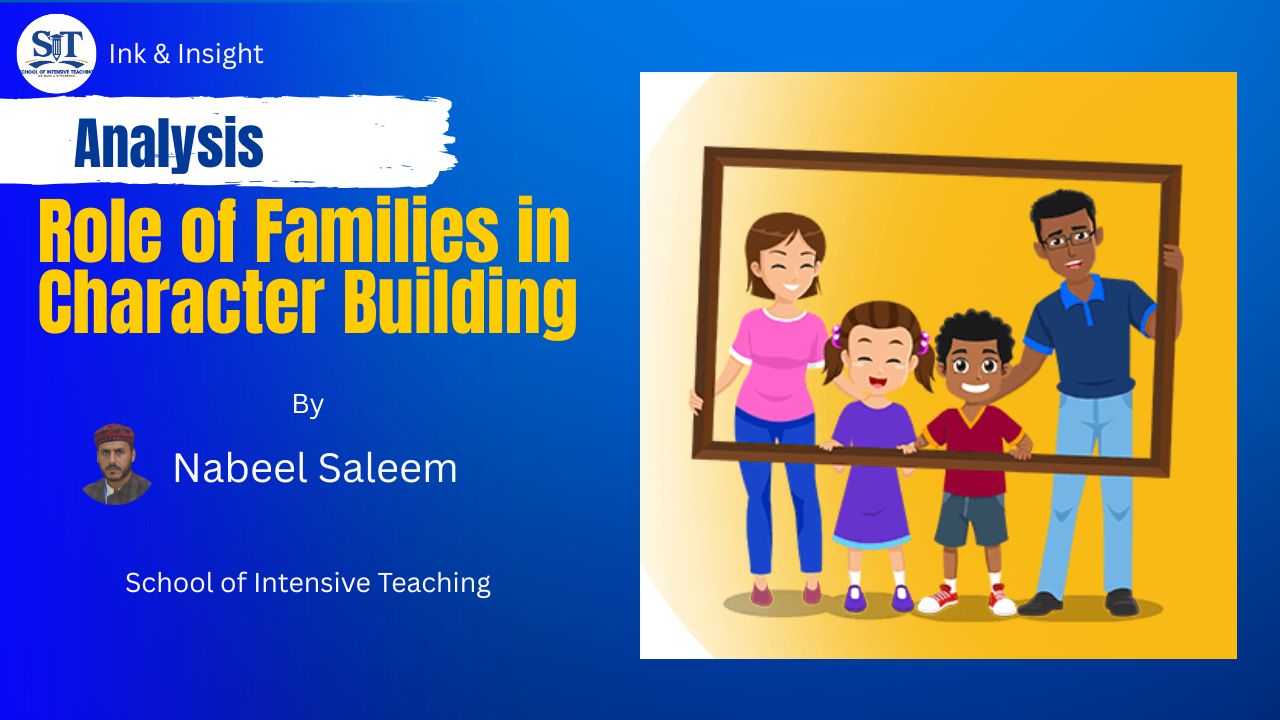
Families play significantly a role to build the characters of children. The most crucial role is the environment. If the environment is beneficial, then parents do not need to put in a lot of effort. However, if the society is challenging, parents not only have to take precautions but also need to have much leisure time to watch out for their innocent children. And whatever they are taught would manifest. Families had played a significant role in the behavior and lifestyle of children.
Firstly, the behaviour is taught by parents. Whenever a child is found doing something irrelevant, a finger is raised against their parents. Parents are responsible for providing the needed stuff, education, and a better life. “The best parents are the ones who see their children as they are and love them for who they are. Acceptance is key to a strong parent-child relationship.” Unknown. When a child does something or acquires something, he will represent his parents in society; for instance, if he gets a job, everybody will first congratulate his parents because he is their son or daughter.
According to research, there are four types of parents, but another category was identified, resulting in five types. Firstly, there are strict parents or authoritative parents who dominate the child entirely. If they cry, she is told to stop and sent to the corner of the room. Not appearing on the exact time of meals, the kid would be deprived from the food. Here she is not able to expose her feelings, whatever she is asked to and she has to do.
In contrast, she marries someone whom she has never met or seen. Pretended to be full of joy, but inside, an individual will be full of sorrow. If she expresses her feelings, her words would be worthless. And this relationship would not be prolonged.
Secondly, Permissive Parents; in this sort, they provide full authority to the child. Whatever he adores, wants to do, and desires to eat, and without hesitation would get because of being the beloved child in the family. All premises are widely open to him. The parents play the role of yes men in nourishment; they believe that fulfilling all his wishes indeed makes him a great kid. However, this kid would absolutely become a couch potato. When he is not capable of achieving something, he fights to get things and also becomes an impatient child. In the future, he would take drugs and completely turn into drug addiction. In the results, exclusively a devastated life would be left in him, or the structure of a dead body.
Thirdly, Authoritative Parents; these parents are scheduled, setting a specific time for the child, for instance, it’s Peter’s reading time, where he must quit whatever he is engaged in and immediately follow. The parents are also supportive; they teach him the rules and the behaviors. Whereas, when the kid is in class, participates in every lecture, and follows the rules while riding. “Punctuality is not just limited to arriving at a place at the right time; it is also about taking actions at the right time.” Amit Kalantri. This clearly shows the fact that how cautious role parents play in a child’s life.
Fourthly, Neglectful Parents; it is the role where parents are mostly not present in their children’s lives. Children are found unaccompanied. They hardly wait for their parents; they do not get a chance to talk to them. It makes them feel that they are alone. Although the child spends all their time studying and participating in competitions, they also receive an award when they achieve one. However, holds his horses to showcase the achievements, but the parents do not have a moment to celebrate his prosperity. He is never listened to, and this drives him to be alone. A trust vanishes from his subconscious. And he contemplates that there is no care in this universe, and does not believe in love.
Ultimately, over-involved parents, who are involved in their child’s life, are also known as helicopter parents. Whatever they do, all together. Since they do not allow the child to do something alone, the child lacks to accomplish the task. He would give up easily, they do not want to do something difficult because a lot of effort is needed. The parents do not create an opportunity for a child to overcome these dilemmas.
Responding more effectively is a key factor in building a child’s character. When they draw the attention of parents, it is necessary to listen to them attentively. Though they speak inconvenient words; if parents reject them, yet it is helpful for the child to have or generate a robust connection with them. ”Listen earnestly to anything your children want to tell you, no matter what. If you don’t listen eagerly to the little stuff when they are little, they won’t tell you the big stuff when they are big, because to them all of it has always been big stuff,” Catherine M. Wallace.
Nonetheless, every individual genuinely plays the role in the family; father, is the head of the family, works for the family or the breadwinner, and performs all the heavy stuff, but never ever complains. While mother also shares equal efforts, she looks after the home, manages household chores, and also works for the family.
Migration hinders a child, following in the wrong direction. Earnestly, parents need to experience what kind of gathering the kid has, and they are endeavouring to prevent the kid from this threatening environment. The best option is to settle where there is a quality of education. Whereas, undoubtedly a child builds up a vigorous behaviour, and he would distinguish what is boon and ban for him. A kid has to be the centre of attention.
In brief, parents must be vigilant about their children’s actions. A respectful tone must be used when addressing them. Just having the hand or shoulder of parents is mostly enough for a child. “Because the best feeling in the world is that your own parents get you, you wanna know one of the most significant factors for childhood success, it is not IQ, it’s family meals.”
About the author:
Nabeel Saleem
SIT Hub AlumnusNabeel Saleem is an alumnus of the School of Intensive Teaching (SIT), Hub, where he also served as a member staff. He is currently pursuing a degree in Islamiat at LUWAMS, Uthal. Nabeel’s academic journey is marked by a strong foundation in teaching and a growing interest in religious studies.