





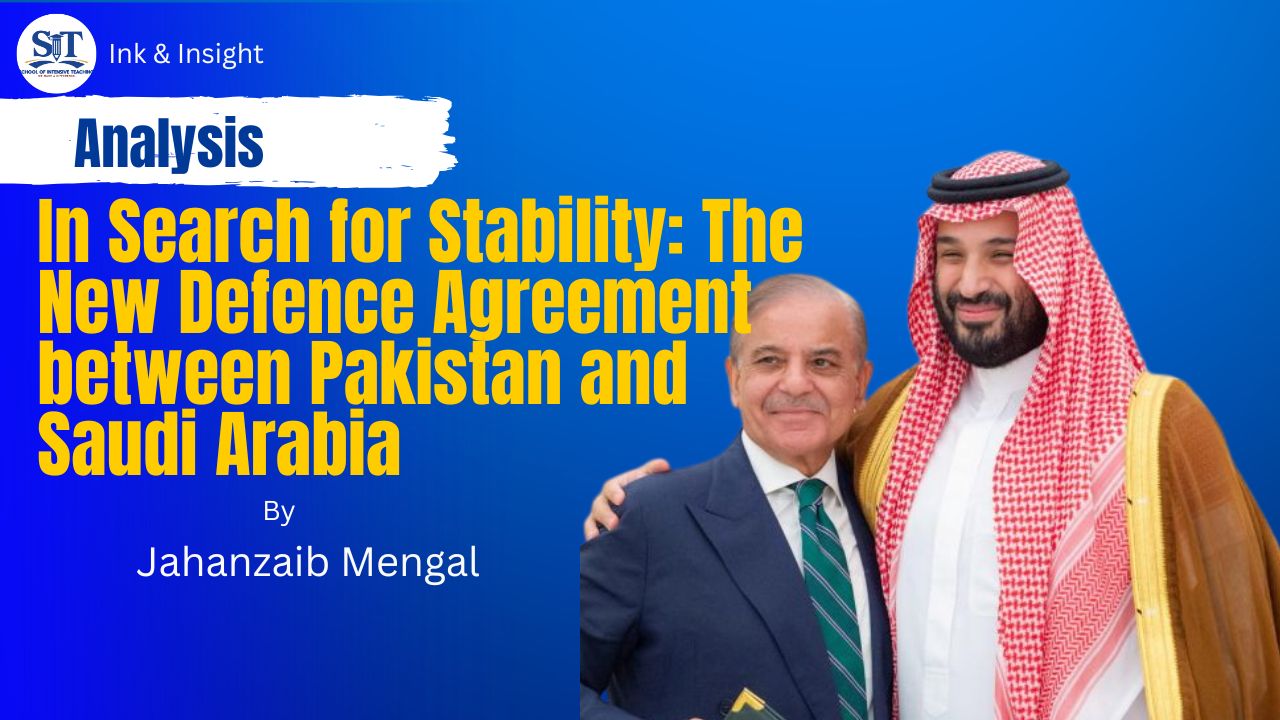
Call it a geopolitical marriage. Every alliance, in history or in today’s world, carries its own theatre. Some are undoubtedly forged in blood, and others are a matter of necessity. The new defence pact signed on September 17 between Saudi Arabia and Pakistan belongs to the latter: necessity. Many, at the moment, are interpreting it as a geopolitical win for both countries. It is, yet, less a triumphal march than a calculated embrace—two countries embracing each other in one another’s shadow: one for security and the other for economic relief and relevance. To the bargain, every embrace carries a heavy weight: Iran and India watch warily, the US is concerned about its waning grip in the region, whispers of an Islamic NATO, and Saudi’s nuclear leap hovers over the horizon. Behind the ceremonial promises and agreements lie significant challenges and overlooked limitations. In this article, I ask: Why was the Pact agreed upon now? What immediate pressure does it face from Iran and India? Could this symbolic union pave the way for an Islamic NATO? Will Riyadh in the near future pursue its own nuclear program?
Why was the Pact agreed upon now?
Desperate times call for desperate measures. For Saudi Arabia, these are indeed desperate times when an Israeli guided missile caused havoc in Doha, Qatar, aiming to kill the Hamas negotiator. Riyadh read the warning with bated breath: either diversify its security guarantees or rely on the half-hearted traditional security assurances of the US. The desert winds of geopolitics are indeed shifting in the Middle East and Saudi Arabia and Pakistan are erecting a joint tent against the storm.
What has caused the storm to be so strong that it compelled Riyadh to erect a tent with Islamabad? Israel. Since October 2023, Israel has attacked seven countries in the region, including the latest attack on Qatar. And in September alone, Israel carried out strikes on five countries, including Lebanon, Palestine, Yemen, Syria, and Tunisia. These attacks have shown an underlying reality to the Saudi’s: the credibility of the US security guarantees. Doha, being the only country to host the most significant military base of America with more than ten thousand US boots, could not be exempted from Israeli attacks, questioning the US role as a security provider in the region. So, how could Saudi Arabia rely on the US security assurances for its defence?
The attack was a nail in the American defence umbrella coffin. The value or the credibility of the US to restrain Israel prompted Riyadh to forge an agreement with Pakistan. As desperate times call for desperate measures, indeed, it is a desperate measure from the Riyadh part.
Why does this Agreement matter?
One clause has brought the Agreement into the limelight. This clause evoked a sense of déjà vu, reviving Cold War memories. A clause that replicates Europe’s NATO article 5: “collective defence means that an attack against one Ally is considered as an attack against all Allies.”
Similarly, the new defense agreement between Saudi Arabia and Pakistan includes a specific clause aimed at collective defense against an attack. However, the prospects of this clause are discussed later in the article.
What does Pakistan want to reap from this Agreement?
Many fruits are hanging above that the country wants to reap. First of all, Pakistan wants to boost its economy with the help of Saudi investment. Then the question arises, will this defence agreement translate into economic cooperation? Secondly, Pakistan aims to ensure its relevance in the Muslim world. These are high ambitions when you claim to be the sole Muslim country to possess a nuclear weapon. Moreover, this Agreement can be the baby steps that turn into heavy steps when Turkey and other countries join the Pact.
Islamabad is playing the role of the sword-bearer at the gates of the Gulf. With this Agreement, Pakistan aims to achieve both economic and strategic benefits. Funding and investments at a time of fiscal strain, and strategically thinking, Islamabad wants to reinforce its standing as a pan-Islamic security provider in the region. Primarily, Pakistan is acting like a blacksmith, hoping to forge economic relief out of military steel. To the limits of these ambitions, they are yet to be revealed.
Saudi Arabia’s interests from this Agreement:
Riyadh has been searching for a shield to guard its oil heartland and the holy sites. The US security umbrella was once considered the ultimate shield. Until Riyadh started to notice the holes in the umbrella when Saudi Aramco, the largest state-owned oil company, was attacked in 2022 by Houthis, this was a massive vulnerability that exposed the claims of US security assurances.
Saudi Arabia, as a falcon, looked for a perch beyond America’s arm that could bridge these strategic vulnerabilities. So this new Agreement in Saudi’s part, strengthens its defence against threats from Iran, Houthi militias, and regional turbulence caused by Israel’s genocidal actions in Gaza. The kingdom long under Washington’s umbrella is now stitching its own canopy with Pakistani threads.
The Elephants in the Room: India and Iran
There are many limitations to the new marriage between Riyadh and Islamabad. The rifle may be pointed outwards, but the neighbours can still hear the click of the chamber. Amir Rana, a security analyst and a Dawn columnist, calls it “A reunion with limits.” He argues that Riyadh and Delhi’s relationship trajectory will unlikely change anything dramatically. Rana is true to a greater extent. The Saudi Vision 2030 which is majorly pursued by MBS vows to reduce its heavy reliance on oil and diversify its economy in other sectors. More importantly, Saudi Arabia considers India a vital partner for this change. It is doubtful that Riyadh might pick Pakistan’s side in the event of a war or hostility. Rana thinks that Riyadh would play the role of the mediator, not choosing sides. So, here comes the first limitation of the Pact.
In the same way, Pakistan is also in murky waters if Saudi Arabia and Iran’s hostilities escalate. Will Pakistan pick a side—ignoring the realities and vulnerabilities of escalating tensions with an immediate neighbour? This is also a significant elephant in the room for Pakistan. These are the major obstacles in front of the new Agreement between Pakistan and Saudi Arabia. Only time will tell whether it will be successful or collapse under its hubris.
Future Possible Prospects from the Agreement:
One thing can be visible from the horizon of Saudi’s desert: a mirage yet untested when one draws near. This mirage is of Saudi Arabia’s ambition to have its own nuclear arsenal. I might sound too foolish, at the moment, to draw this conclusion, but events of the past in the Middle East point in this direction.
International relation theorists argue that survival is the ultimate and only goal of any state, and states can go to great lengths to attain this end. In the case of Saudi Arabia, the region’s security dynamics have been volatile over the past few years, and Riyadh has become desperate to ensure its survival in the face of Iran and Israel’s recent escalation. This might act as a push factor for Riyadh to attain the unimaginable weapon.
If Iran can pursue a nuclear weapon program or ultimately achieves it, what would be the vulnerabilities of Saudi Arabia? Will this Pact or US security assurances be enough? There is no denying the fact that Saudi Arabia might in the near future pursue a clandestine nuclear weapon program to achieve its strategic vitality and act as a net security provider in the region.
In the end, it will depend on how both governments to whether this pact stands firm like a fortress or collapses like a tent in a storm, if they fail to manage the challenges ahead. For Pakistan, the immediate pull factors are the economic and strategic benefits. For Saudi Arabia, it is mainly about reducing its exposure to shifting regional security threats. The immediate challenges from India and those from Iran will impose many limitations on the reunion. Saudi Arabia will be more reluctant to pick a side in the face of Pakistan-India hostilities, and the same case is with Pakistan. All in all, it is a geopolitical marriage born out of necessity and shared interests.
About the author:

Jahanzaib Mengal
Inspector of PoliceJahanzaib has done his graduation in BS Hons in International Relations (IR) from Quaid-i-Azam University, Islamabad. He writes on international politics, Indian Ocean dynamics, and national security issues. Currently serving as an Inspector of Police in Balochistan’s Home & Tribal Affairs Department, he has also published a research article, “String of Pearls and Necklace of Diamonds: Sino-Indian Geo-Strategic Competition in the Indian Ocean”, in the Asia Pacific Journal (open access).