





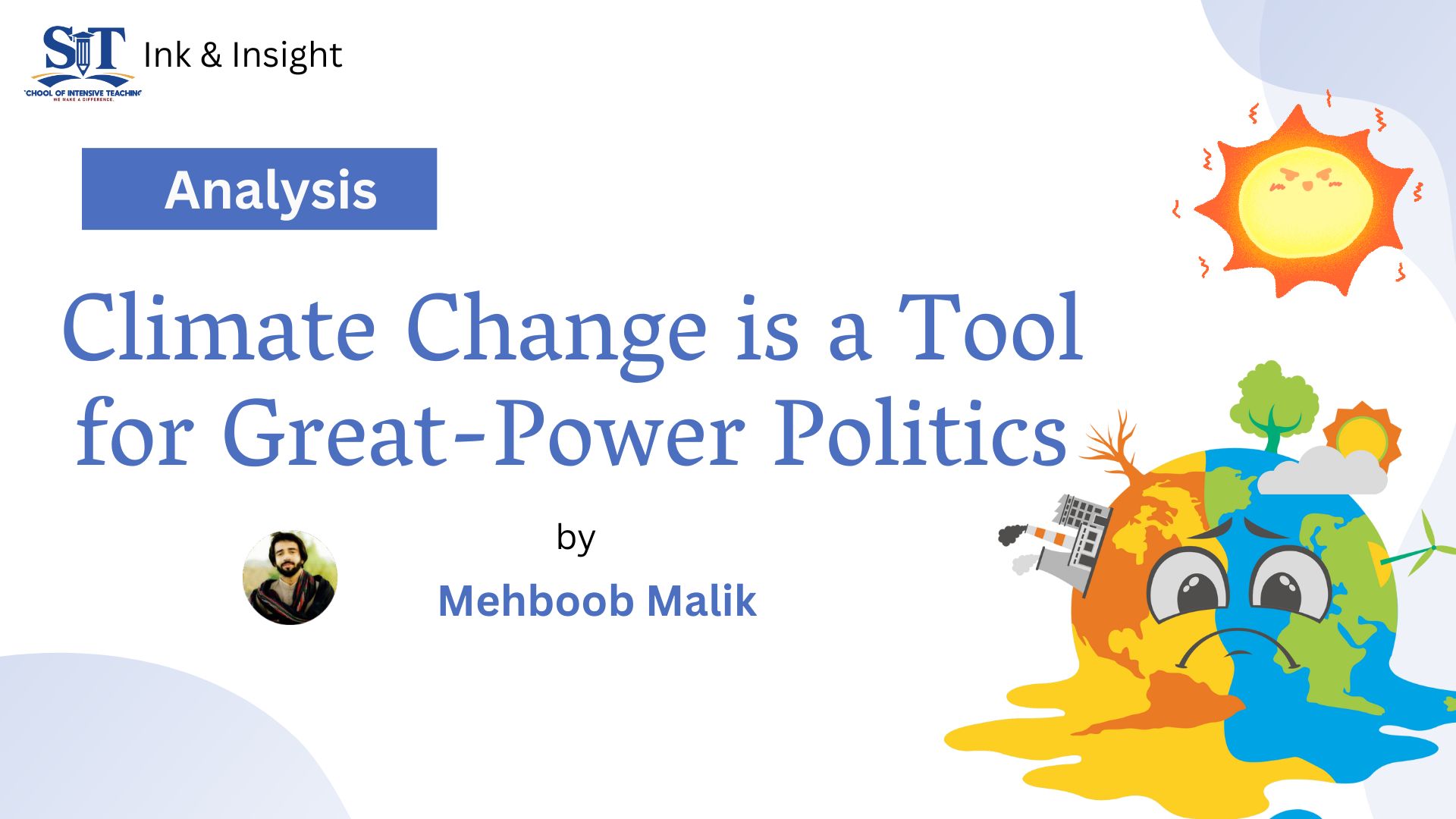
Climate Change is far more lethal than nuclear, biological, and chemical weapons. For the first time in history, humanity recognized it as an existential threat in the 1970s and 1980s, coming under the attention of global leaders. Since then, it has been exacerbated by human activities in various forms. With its rapid trajectory, climate change is costing the world billions of dollars economically. Moreover, it is also costing millions of lives in human capital. Despite these costs, the situation escalates rather than stabilizes. This increasing shift is not due to unawareness but to its politicization. The more global leaders use it as a political tool, the better it serves their interests. True, global leaders pay lip service to climate change while pursuing their interests rather than resolving the problem.
To begin with, climate change is one of the most effective tools for the Global North to achieve its ultimate goals. Burying its corpse at the heart of the international community, the coordinators present it as a hoax of the Global South, as opposed to an undeniable threat. To generate more money, wealth, and power, Europe, along with the U.S., always sees climate change as a source of revenue. Consider, for example, Mr. Donald Trump saying, “Hoax of China,” while surely knowing that it is an existential threat to all of humanity. Similarly, during his second-term presidential speech, Trump said, “Drill, baby, drill.” This means he presented himself as an advocate of increasing gas and oil production. Therefore, climate change is not just a danger but a bona fide opportunity for the West.
Climate finance is a weapon of exploitation. Given the sweeping roles of Western funding institutions such as the International Monetary Fund (IMF) and World Bank (WB), their influence in poor regions is stark blackmail. Once they lend money to weaker countries, they demand structural reforms. The same goes for China’s Belt and Road Initiative. First, it installs solar panels, and second, it extracts natural resources. In the same token, the developing nations in the world are being economically colonized in the name of climate resilience. This is a tragedy, not justice. This is the politicization of climate change, not its eradication. Ergo, the financing climate has become a novel approach to dominate the weakest.
Moreover, climate diplomacy is nothing short of a new currency of influence. The global elites attend summits and build towering narratives of billions. Before returning home, they approve of new fossil fuel projects, digging the graves of future generations. The retreat of the United States, which contributes 20% of funding, from the Paris Agreement, USAID, and the WHO, is a glaring example. The grand forums, such as the COP conferences, are less about real solutions and more about appeasing the public. Every promise of “Net Zero” has become just a pretext to defend their interests. Hence, this is how troubling the global elites are through climate diplomacy.
In addition, the climate crisis is a unique form of green imperialism. The affluent regions, which are major contributors to carbon emissions, dictate to underprivileged states how to behave, while simultaneously cutting funds and limiting technology and resources to them. In this connection, Africa is asked to protect its forests while Europe expands its industries. The same is true for the Global South, which is directed to transition to clean energy. At the same time, the Global North subsidizes fossil fuel giants. The hypocrisy is sharp; those who pollute the skies now pretend to be the saviours of the earth. Through the banner of “climate leadership,” they exert control over trade and aid in weaker states. Climate change, thus, has become a weapon of economic discipline.
Establishing organizations for climate adaptation and mitigation worldwide has become an excuse for global power competition. Whether it be China, America, or Europe, each has its interests. For instance, the U.S. Climate Change Program (CCP) from Latin America to Africa, China’s South-South Climate Cooperation Fund (SSCCF) from the Middle East to South Asia, and Europe’s Global Climate Change Alliance Plus (GCCA+) throughout Europe are locked into an unending race for power. Each of these big players provides funds to the developing world not in the spirit of relief, but to solidify their clout in respective regions. In contrast, when it comes to actual mitigation, they label it as not a tangible reality. Thus, it is all a game of power in the name of climate mitigation.
Climate change represents a significant threat to humanity. Emerging wildfires, from California and Chile to Athens, Turkey, and South Asia, have become a new normal in the realm of climate change. These fires destroy whatever comes in their direction. Similarly, climate change is not only limited to wildfires, but it also includes extreme heat-waves, flash floods, rising sea levels, melting of glaciers, droughts, and many more. It has costed billions of dollars and millions of human lives globally. Who will bell the cat? Crushing all of this under their powerful boots, global leaders view it as a “Hoax,” achieving their ultimate goals by exploiting climate change.
In this regard, the leading organizations like UNFCCC, UNEP, WMO, IPCC, and GCF are dead elephants in the room. So, climate change is a natural atom bomb, ticking to burst. However, there also exist concerned nations and institutions such as Germany, Sweden, and Costa Rica, genuinely working hard to reduce carbon emissions and tame Climate change, including EEP. What is surprising is that most nations are pursuing their interests under the pretext of climate cards, with Global North involvement being particularly high. It is also true for the Global South. The world is not one the same page against the war on climate change.
Mutual coordination between nations is the core of the leading solution towards the eradication of climate change. Although everyone contributes in climate change, it is the responsibility of international community to advocate for equal and fair distribution of resources for climate mitigation. Though technology can help to combat climate change, it requires significant investment and skilled operators. The world moves in different directions, so people should too. None of this means that no one has voiced their opinion before. Greta Thunberg, Vanessa, and Leonardo DiCaprio are leading voices in the fight against Climate Change. The same is true of nations that have directed their portion of wealth to eradicate it. The primary goal should be to increase contributions, investment, and technology deployment, while reducing politicisation, resource extraction, and the use of fossil fuels.
Civil societies and public awareness campaigns are crucial in this regard. Once, Barack Obama was of the view, “We are the first generation to feel the effect of climate change and the last generation who can do something about it.” Global leaders act without restraint at the expense of the public. Still, it is international intellectual capital that can rein in authoritarians through their pen, voice, and consciousness. From the bustling cities of Uncle Sam and Norway to the gutter-flooded streets of Congo to the acidic oceans of the Global South, everyone should share their fair contribution to mitigating climate change.
To cut a long story short, climate change represents a significant threat to humanity, being a double-edged sword. Moreover, it is not only limited to environmental problems, but also a litmus test for the global leaders. The global leaders, at the expense of the weakest, continue to politicize and profit from the crisis. Furthermore, the international community, along with climate activists, writers, and active global organizations, should rein in the lavish leadership of the world. In addition, when it comes to the mitigation of climate change, it requires genuine climate actions such as massive investment, conscious use of technology, and a dedicated group of climate leaders who prioritize climate justice over power. Otherwise, humanity no longer survives this ticking time bomb. Such structured exploitations have far-reaching consequences if cooperation, awareness, and accountability are not adopted.
About the author:

Mehboob Malik
SIT Hub AlumnusMehboob Malik hails from Panjgur, Balochistan. He is a SIT alumnus and a former member staff. He is currently pursuing Sociology from UMT, Lahore.