






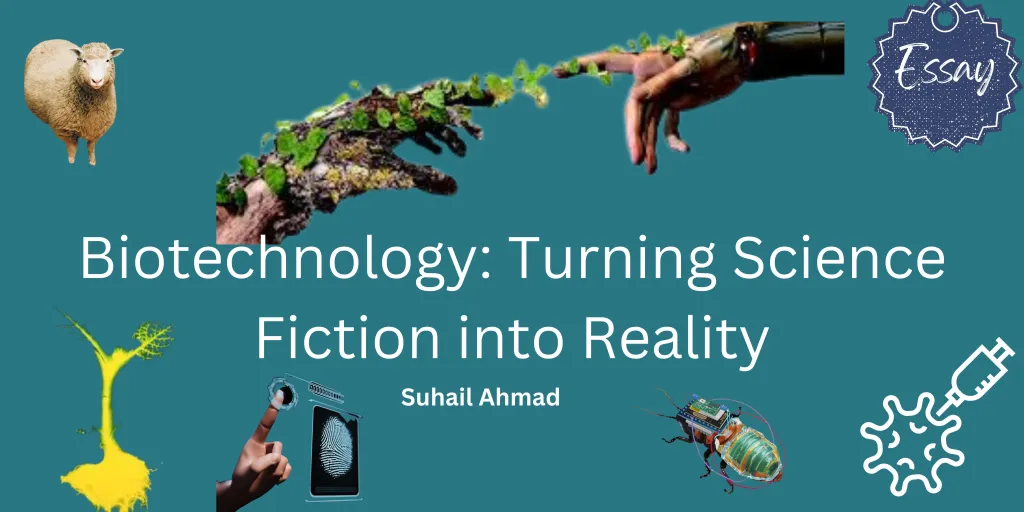
By Suhail Ahmed
Biotechnology is not about improving the quality of life. It is about saving lives, preserving the environment, and creating a sustainable future for all.
The above quote by renowned researcher and author Richard L. Oliver comprehensively portrays the benefits of biotechnology. There is no negating the fact that human life is incomplete without technology in this contemporary world. If one has a comprehensive glance at the Human panorama, it is utterly cocooned by technology. Considering technology’s vast implementations, some pessimists are concerned about its negative impacts, like Artificial intelligence; this concern has put scientists in a dilemma. Instead proper technology utilization, like the usage of cyborg critters during disasters, the production of transgenic plants and animals, cloning, and the creation of vaccines, are sufficient to overcome different forms of crises. Considering the benefits of technology, biotechnology tops the list in this regard.
What is meant by Biotechnology?
According to Merriam-Webster dictionary, “Biotechnology is the manipulation of living organisms or their components to produce useful commercial products,” then how can biotechnology be used to produce useful commercial products, and how can its implementation save, preserve, and sustain life and the environment?
How is Biotechnology used to sustain life and environment?
Recently Turkiye was affected by a calamitous earthquake, and thousands of people were buried for weeks. The tracing of people under rubble was a daunting task for a human. What if miniature creepers like cockroaches were used instead of humans to trace people buried? Indeed, it could have made things much more accessible if cyborg critter technology had been used. In this technique, the cockroaches are implanted with micromachinery in their thorax, through which the bug’s movement can be controlled manually. Thus multiple cockroaches could be coordinated through this program, making it easy to trace things out from smaller spaces where the human approach is inaccessible.
Besides saving lives during disastrous situations, biotechnology also helps reduce energy consumption and overcome water and food scarcity. The National science foundation researchers at California University altered the genetic makeup of a tobacco plant by introducing the firefly (locally known as Jugnu) gene into its DNA. Resulting in a glowing tobacco plant at night like a firefly. Hence this plant was planted along roads and other places to reduce electricity consumption. Along with this, the technique can also be used to get desired fruits and plants.
A typical example is the Persimmon fruit (locally named Amlog), in which the sweet juice of watermelon is implanted into tomatoes, resulting in a new fruit. Likely through transgenic plant technique variety of pest-resistant crops and plants with high survival chances during drought can be developed. This transgenic plant technique can help reduce water and food scarcity and get desired selectively bred overproduction.
Parallel to the above-cited, the DNA fingerprinting technique has made humans capable of reducing crime rates and has made identification possible even between identical twins. Referring to the importance of DNA fingerprinting, well-known American politician and author Eliot Engel says, “DNA fingerprinting has revolutionized forensic science and the ability of law enforcement to solve crimes.”
In addition, another well-developed technique is cloning. However, some pessimists often argue its ethical and social implications, but its implication can help to revive extinct animals and save endangered species from extinction. Clones can also preserve beneficial traits within species, as Dolly sheep was the first clone in 1996.
Above all, biotechnology has played a vital role in the health sector. Introducing biotechnological tools such as DNA sequencing and gene editing has improved the diagnosis of diseases. Biotechnology provides us with the discovery of diseases and helps us cure them with the latest techniques. Implementing rDNA (recombinant DNA), technology has sped up the production of vaccines. In this methodology, the structure of disease-causing viruses and pathogens is mimicked. As the mimicked structure is inserted in the body, this spontaneously stimulates an immune response from the host body. Thus activating the body to fight against antigens. The same technique was used to create vaccines like Pfizer, BioTch, and Moderna to immunize humans against the Coronavirus.
In the same pattern, gene therapy is another approach in that the defective or missing genes are either repaired or replaced with healthy ones. Equivalently, regenerative medicines are used to regenerate or replace damaged or diseased tissues and organs. Thus, through the techniques mentioned above, humans have been able enough to cure genetic disorders that were previously untreatable.
In a nutshell, properly utilizing this rapidly advancing field of science can provide man with better food and health and help in the sustainability and preservation of plants and wildlife.
About the Author:

Suhail Ahmed
Contributor at SIT Ink & InsightSuhail Ahmed hails from Panjgur, Balochistan. He has done his graduation from the University of Balochistan in Zoology. His interests are in wildlife and marine science. He tweets @SuhailAhmad