




The words of Leon Trotsky expound the policy of the USA, “You might be not interested in war but war is interested in you”. But in the case of the USA, it has to engage in overseas conflicts to secure its national interests, and allies and maintain hegemony. Since WW-II the US kept on engaging in conflicts that were in the covert interests of its institutions, lobbies, and politicians. Every conflict was an opportunity to divert a significant amount of money to certain institutions and industries. The political economy behind the US militarism directly led to the Military-Industrial Complex which has evolved into an autonomous institution.
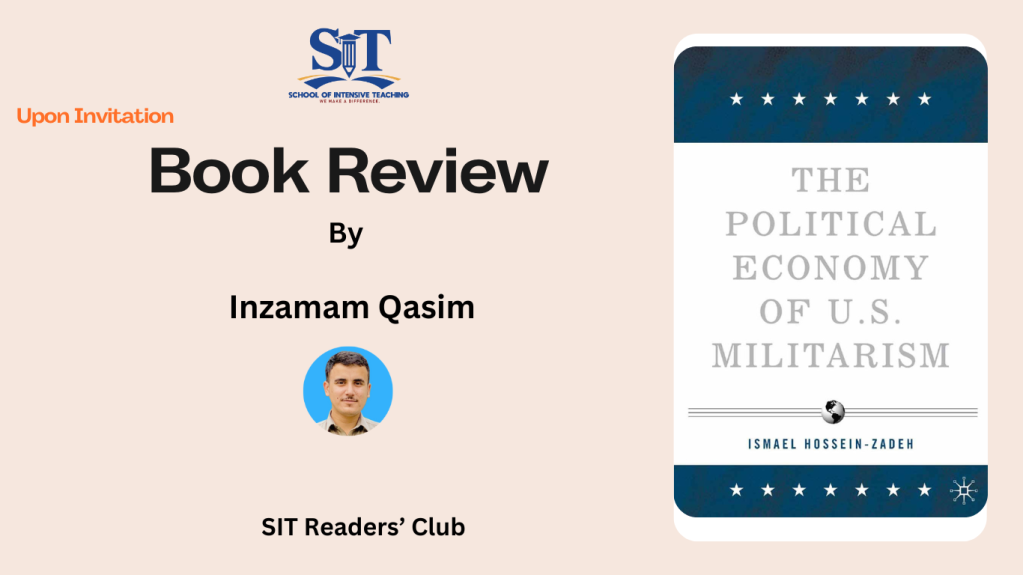
Ismael Hossein-Zadeh’s book, “The Political Economy of US Militarism” is an account of political and economic covert interests behind its militarism in the world. The burgeoning military empire is not the means for something but an end in itself. The privatization of war created its imperatives for the market. Private ownership and the market-driven character of the arms industry have changed the conventional principles of demand and supply. The ‘Industrial’ factor of empire makes it an enterprise that maintains an international threat to continue the unhindered flow of resources. In primitive times, the military was meant to advance the political and economic ambitions of the country. Same as that Britain followed the policies of mercantilism to flourish its industries, and at the same time military was a tool to tame the masses. Imperialism was a catalyzing factor in the thriving of economies. However, in the case of the USA; military imperialism has been cumbersome for the economy. The military as a means for geopolitical ambitions costs a lot in terms of the economy at the expense of the social expenditure of the country.
After the cataclysmic world wars, the USA more relied on the military for its geopolitical interests and containment of Soviet influence.
The book is compartmentalized into nine chapters. Each chapter aptly delineates the Military-Industrial Complex as an institution and unravels the quandary of how it evolved into an industrial empire. The first three chapters are about the military-industrial complex, its past, and future, and the meteoric rise of the military as a cardinal factor in the pursuit of the interests of the USA. Remaining of the chapters deal with the discursive construction of external threats; Fascism, Communism, Axis of Evil, and Islamic fundamentalism. He also makes startling claims about the role of neo-conservatives in the manipulation of the US administration and the pivotal role of the Likud lobby in engaging the USA in the Middle East to keep it unstable for the interests of Israel. The book also shatters the myth of, the “Clash of Civilizations” by stating it was an overreaction to the threat which had political and economic orientation other than a cultural civilizational tinge. The illicit economic interests were camouflaged by calling the heresy as a threat to the democratic principles of the USA.
In recent times, the character of the military has evolved from the primitive times military. In the pre-capitalist era military was maintained and sustained to further the geopolitical interests and economic interests of the country. The spectre of external threats was portrayed as an existential threat to maintain the elite status of military officialdom. Britain maintained a large naval force to secure the supply lanes of the world for its economy. Conversely, the rise of the market and, the rise of classic capitalism- as advocated by Adam Smith- resisted state interference in economic affairs.
Every conflict is an opportunity to divert a significant amount of money to certain institutions and industries. The political economy behind the US militarism directly led to the Military-Industrial Complex has evolved into an autonomous institution.
Adam Smith further emphasized that the market itself can be regulated through the invisible hands of demand and supply. The market economy vehemently opposed state regulation and propelled a new idea that Britain didn’t need a military for its superiority in the international market but through the utilization of its central productivity it could maintain its dominance in the world. The book also debunks the premonition of Lenin that imperialism is the highest stage of capitalism. As the whole edifice of capitalism is based on the unhindered flow of market resources and less regulation of the state. Based on the premise that capitalism supports the law-based order, how capitalist countries can go to war? Paul Kautsky said that the capitalist elite always opposed the war owing to its detrimental consequences on the market economy.
After the cataclysmic world wars, the USA more relied on the military for its geopolitical interests and containment of Soviet influence. The USA went against its post-war principle of demobilization of its forces. It was a premonition of Dwight D. Eisenhower that the mushrooming influence of the military-industrial complex was a threat to democratic principles. The opposition was not to the military but its militarism which could undermine its democratic ethos, and public opinion and corrupt the decision-making process of the country. Moreover, the Iron Triangle; the Pentagon, its contractors, and the congressional committee; supported imperialism which benefitted them. An increase in the defense budget meant more contracts for the congressmen for their constituencies and the creation of more jobs. For the increase of budget, the Iron Triangle has to maintain an external threat of Communism, the Axis of evil, rogue states, Islamic Fundamentalism, and the War on Terror. The role of neo-conservatives (Dick Cheney, Donald Rumsfeld, Paul Wolfowitz, and Condoleezza Rice) and Likud lobbyists remains decisive in the US foreign policy. That’s why the abominable invasion of Iraq was opposed from all corners of the world and the USA. The scandals of trillion dollars’ corruption were divulged by reports. Chapter 07 of the book unearths the mystery behind the waste, inefficiency, and spoils of the US defense budget.
“The USA has crossed that metaphorical Rubicon which caused the demise of the Roman Empire.”
Furthermore, the burgeoning defense budget of the US is not cut from the tax of the elite but from social sector expenditure. Every 10 billion dollars spent on the arms industry creates 40,000 fewer jobs than spending on the private sector. In the worst scenario, the spent money on the arms industry creates international convulsion which brings more death and destruction. The USA has crossed that metaphorical Rubicon, which caused the demise of the Roman Empire. The military adventures abroad will drain the hard-earned taxes of poor people. The USA has to rekindle its strategy and revise the policy of unilateralism, militarism, and disregard for the international system.
In the end, the book is an excellent account of the political economy of militarism. The book is replete with facts and figures which embolden the arguments of the writer. It is a well-recommended book for the students of social sciences.
About the Author:

Inzamam Qasim Silachi
COntributor at SIT Ink & InsightInzamam Qasim studied International Relations at Quaid-i-Azam University, Islamabad. He hails from Sibbi, Balochistan. He tweets @inzamam_qasim