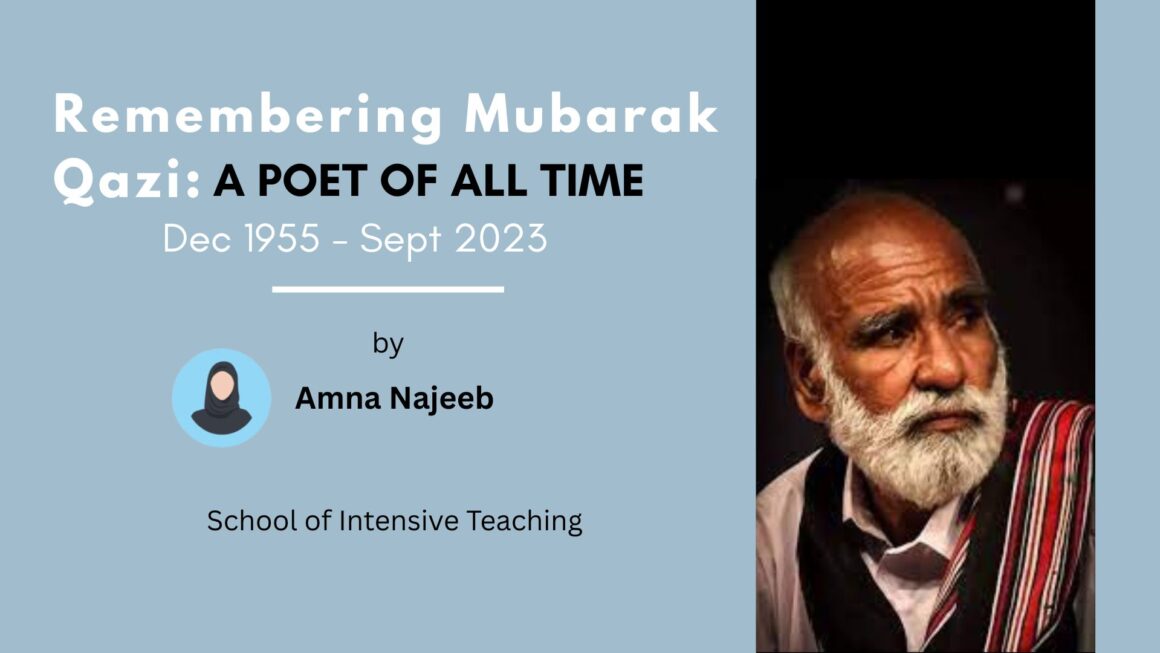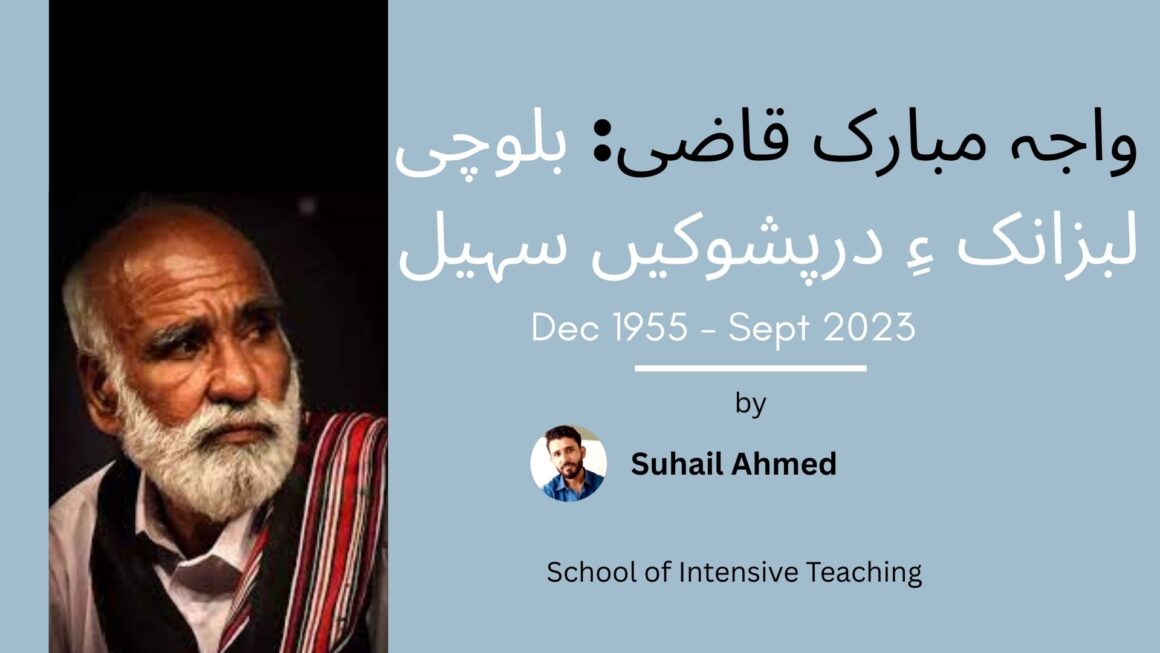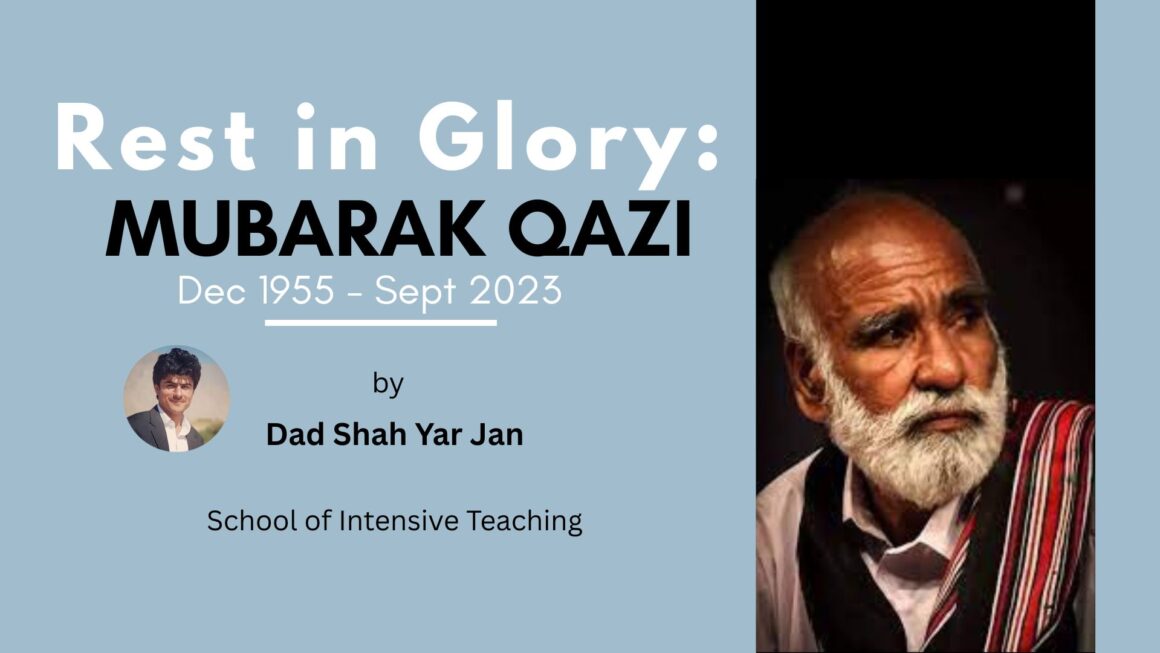




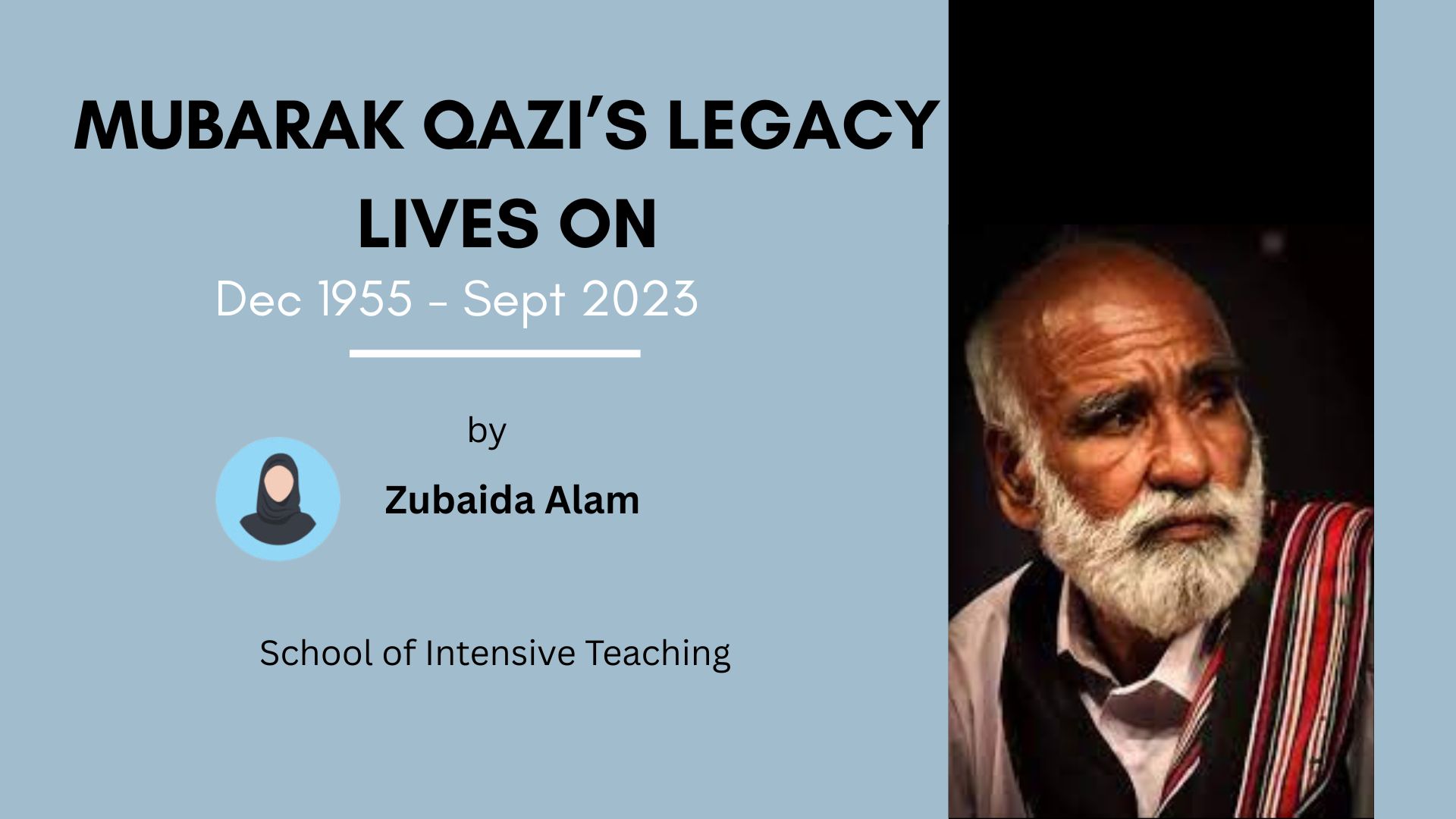
It was the dawn of September 16, 2023, when the entire province of Balochistan mourned as the sun rose. All the rallies, social media posts, and news headlines presented one name: “Mubarak Qazi.” A young man named Naseer Ahmad, weeping and wiping away his tears in a video while standing in front of a crowd gathered in the streets of Pasni, kissed the picture of an old, bearded Man. While I was wondering, I had seen this older man in the picture before. The Radio Zarambash Urdu announced that Mubarak Qazi had passed away in Turbat. My thoughts couldn’t capture his image completely, but they reminded me of one of his cathartic poems.
falsehood glows bright
And the truth is lost
In the dust of night”
Following that, I remembered he was the same poet whom the birds of Balochistan welcomed, and the youth listened. Today, September 16, marks another year since the renowned poet Mubarak Qazi left the land of Balochistan, shattered with hope, but with the hearts of the people healed by his words. With his remarkable contributions to Balochi literature, his legendary performance encountered various challenges before placing him to hearts of everyone.
In the coastal town, Pasni, of district Gwadar, Balochistan Mubarak Qazi was born on December 24, 1955. In Pasni, as far as one’s own eyes reached, they met the blue ocean and on the opposite side, the barren desert. History has noted that the town was renowned for its natural beauty and for producing exceptional poets. Similarly, Mubarak Qazi’s journey initiated from the same land. He completed his matriculation in 1972 from Pasni. As he couldn’t access further quality education there, he was compelled to leave his hometown and shift to Karachi. He reached the city seeking knowledge, which ultimately became a motive for him to be admitted to Sindh Muslim Arts College. However, his financial difficulties became a barrier to his career. Despite taking gap in his educational record, he qualified a BA degree. After that, he completed Master’s in International relations from Balochistan University in Quetta.
In an interview, when Mubarak Qazi was asked about his approach to literature, he replied with a simple and compelling statement. “A poet is not made but born as a poet.” Nevertheless, he had been born a poet; his literary journey holds inspiring narratives. His house created an environment of literature and poetry. At the age of twelve, he could read and write his mother tongue, Balochi. Apart from Balochi, he also read Urdu and Farsi, as his inspirations include Ghalib.
Additionally, while sharing a memory of his childhood with Ishaque Kamosh in an interview, he mentioned that when he was in 6th grade, he translated some Balochi words into Urdu and ranked second. He received appreciation from his teacher and kept writing more. During his educational gap years, he worked at a water supply hub in Basul, Ormara, a peninsula town in the Gwadar district. The forest (basul) where he worked, the darkness where he spent his nights, and stars in the sky which he used to gaze at, persuaded him to write, said Qazi. He discovered the introverted poet within himself, to whom he spoke and wrote.
Early on, he wrote about love, women, and romance. Still, he soon became well known for his poetry on resistance and the socio-political struggles of the Baloch community. The simplicity and creativity in his words became a melody for the Baloch people living in every corner of the world when the ocean sang it with love. Afterward, he continued writing until he had proven his words. “ I want my poetry to reach every house.” Moreover, he published several collections of poetry, some of which include: Zarnawisht (Golden words), Hani Mani Mahti Watan (Motherland), and Shaag Ma’n Sabz’ en Sawada ( A boat in the blue ocean).
As his contributions to Balochi literature were being celebrated throughout the Baloch community, his esteemed status was, sadly, confronted with several setbacks. In 1982, when he joined a protest for Baloch Students Organisation (BSO) leader Hameed Baloch, he was jailed. Again, in 2006, while on his travels, he was asked for his identity, and he was put behind bars for arguing that, as a local of this land, there was no need to prove my identity. He remained jailed for 8 months in Turbat. Later on, in 2014, his beloved son Dr Kamber’s death turned his living soul into an abandoned heart. All these difficult periods provoked insightful meanings and feelings in his poetry because nothing remained for him to lose. His soul was dead, only the unleashed body with echoes of painful experiences remained.
Regrettably, such a revered figure wasn’t gifted a long life. On September 16, in Turbat while in his sleep, he suffered from a heart attack and passed away.. Even so, today he is known as the “Revolutionary poet” who wrote for his people and land. Though his soul has long since passed away, he is and forever will be alive in the verses that people listen to, feel, and speak.
About the Author:

Zubaida Alam
SIT Hub AlumnusZubaida Alam is an alumnus of the School of Intensive Teaching, Hub. She has been a member staff at SIT Hub.