




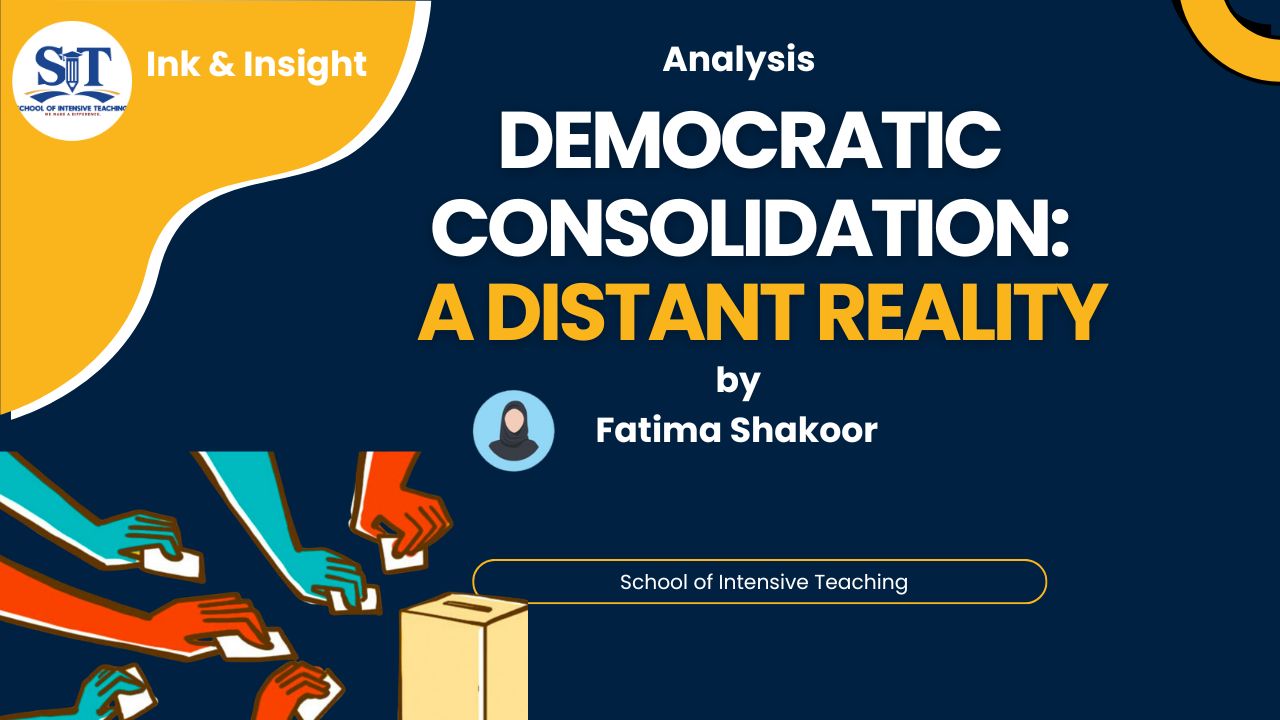
The term democracy comes from two Greek words ‘demos’ meaning ‘people’ and ‘kratein’ meaning ‘to rule’. It is a system of government where citizens have the liberty to elect their own representatives through elections. These elected members then make decisions and laws on their behalf. Abraham Lincoln has described democracy as “government of the people, by the people, and for the people.” However, looking into Pakistan’s democracy it seems the quote does not resonate well. The Constitution of 1973 ensures all the fundamental rights and sets procedures and rules for the fair and transparent conduct of electoral rights. Are they being followed in true letter and spirit? Is democratic consolidation a reality in Pakistan or still a pipe dream to be achieved yet?
In Pakistan, elections are held — but are they truly transparent and free from manipulation? No.
Freedom of speech exists on paper, but do journalists and ordinary people truly feel safe speaking the truth? No. Do the powerful elites face the same justice as ordinary citizens? No. A democratic system guarantees media freedom and judicial independence; however, in Pakistan, can the media report honestly without pressure, and is the judiciary always free from influence? Sadly, the independence remains pressured.
Political parties are the gatekeepers of democracy in any country. Elections are the backbone of it. However, in Pakistan they have often been questioned. For instance, the recent General Elections of 2024 were heavily criticized with allegations of vote rigging and delayed result. Many international watchdogs including United States, United Kingdom, and European Union also raised serious concerns about the fairness of the process—as the country went for voting. All the election was conducted in internet blackout. There have been concerns that the predominant party, Pakistan Tehreek e Insaf, was selectively out favoured days before the elections as it was ripped off its electoral symbol—the ‘bat’. Isn’t it a political manipulation? Does it not hurt the electoral process and democratic consolidation in the country?
Similarly, Media outlets around the world even described the elections as “fraudulent,” suggesting that the outcome was already influenced in favour of certain powerful groups. It seems the country has not learned from the history. The repeated direct interference in shape of coups in 1958, 1962, 1969, 1977, and 1999 have pushed away democratic consolidation. Not only direct intervention, but also indirect manipulation and vote-turning has also weakened democratic roots in the country. When political interventions are made in politics, democratic institutions lose their strength and value. When the elections are influenced to favour a few and cronies and the results are predetermined, it suggests that our votes don’t matter.
Politics has become a tradition, dominated by dynastic politics. Major parties, such as PML-N and PPP, and even smaller regional parties, often treat leadership as a birthright. Few families in the country have considered politics as a family business using it as a source of personal luxury and wealth. The top slots of leadership are being distributed as political rewards to those who had stayed loyal. Dynastic politics is the best mockery of democracy as these families who own the party majorly focus on maintaining their power than focusing on solving the problems of the people. This seriously affects and weakens democracy and furthers voter apathy.
In the recent example of the Kohistan mega corruption scandal in Khyber Pakhtunkhwa, a large amount of public money was discovered, which was intended for development projects but was being misused. NAB (National Accountability Bureau) has arrested many individuals including government officials and has recovered assets worth of Rs. 25 billion—with lost funds ranging from Rs. 30 to 40 billion. Unfortunately, these funds were meant to be spent for the province’s basic infrastructure and public welfare but were diverted for personal gains and wealth. This case shows the lack of accountability among influential individuals. That’s how people lose trust in government when the powerful continue to benefit themselves while the citizens suffer.
The road towards democratic consolidation is far ahead and democracy , at the moment, is a hostage. In order to bring democratic consolidation, the country has to bring massive reforms and initiatives. Every citizen has the fundamental right, as enshrined in the constitution, to stay informed, demand justice, and speak sans fear. Leaders are accountable and every casted vote must be respected and valued.
About the author:

Fatima Shakoor
SIT HubFatima Shakoor is a student of Level Three class at School of Intensive Teaching, Hub.